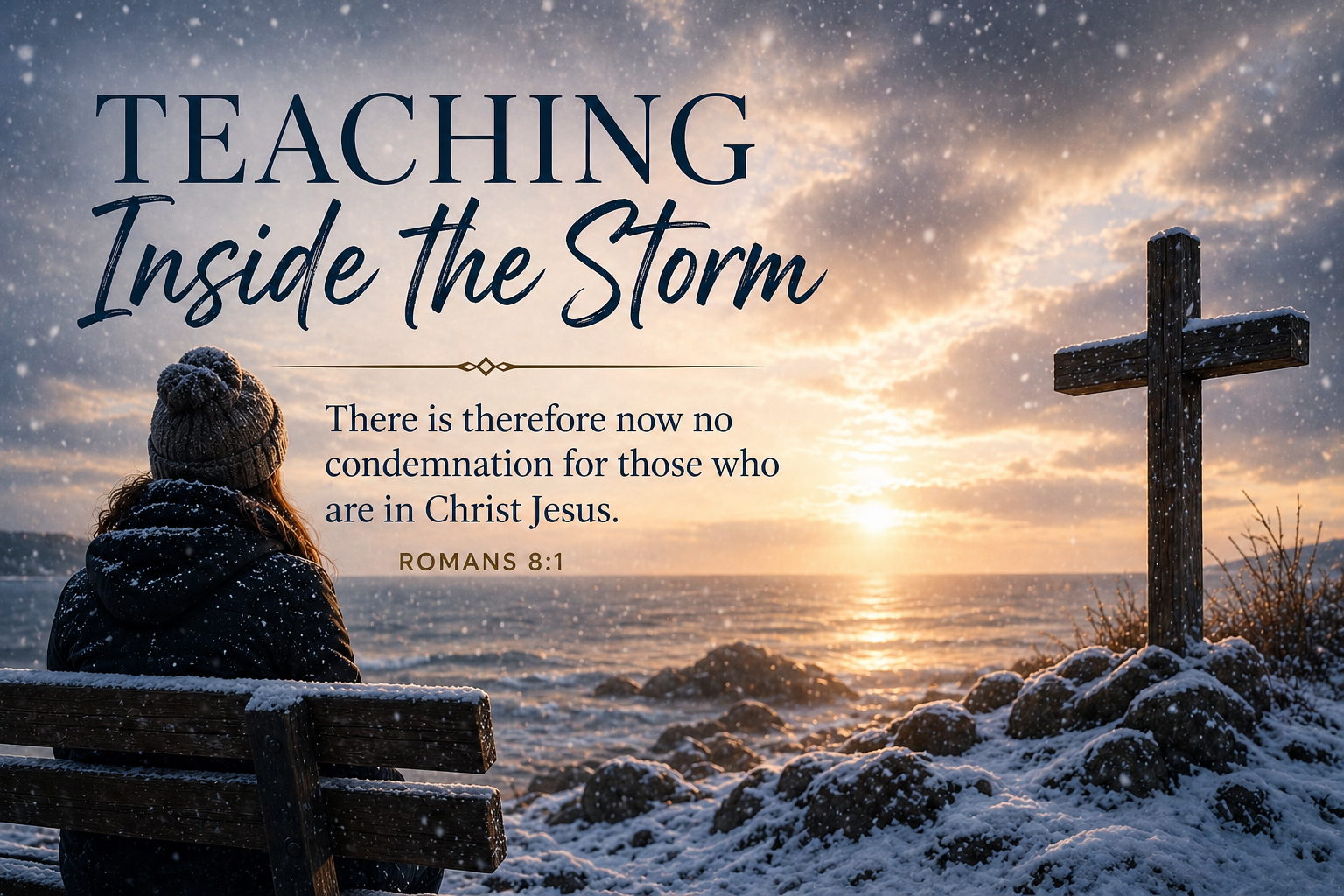
I woke up before the alarm, which is nothing new. I rarely sleep all the way through anymore. The house was quiet in that early-morning way—not peaceful exactly, just paused. Like everything was holding its breath.
I stepped outside into the cold. Snow was already falling—big flakes, the kind that don’t rush. They floated more than they fell, drifting sideways, catching the light, hanging in the air as if gravity were optional for a moment. I stood there watching them longer than I meant to. My mind registered the beauty immediately. The quiet. The way the world seems gentler when it snows like that.
But my body didn’t follow. Almost immediately I felt it—tightness creeping up my neck, settling into my shoulders, running down my arms. That familiar readiness. The one that doesn’t come with words, just sensation. The one that says be alert, be prepared, don’t relax yet. It struck me then, almost with surprise: my mind and my body were having two completely different mornings.
My mind was calm.
My body was bracing.
And for reasons I still don’t fully understand, that realization landed differently this time. Not as frustration. Not as shame. Just recognition. No one ever taught me that those two things could be different. So I stayed there in the snow. Let it land on my coat, my hands, my face. Let the cold remind me I was actually here. I stood there and breathed. And in my own head—almost the way you’d talk to a nervous child or a skittish animal—I let my mind speak to my body.
We’re okay.
Nothing is required right now.
You don’t have to run this moment.
It felt awkward at first. Almost silly. But it also felt strangely right. Like something ancient. Like something I should have learned decades ago. I’ve lived most of my life in survival mode. Especially the last eighteen years. Survival mode doesn’t always look dramatic. Sometimes it looks like competence. Responsibility. Being the one who stays steady when everything else wobbles. It looks like planning ahead, scanning the horizon, making sure the bills are paid, the bases are covered, the worst-case scenarios already mapped out. Or whatever it is you’re carrying today. Grief. Debt. A broken relationship. Fear for your kids. Fear for yourself. The quiet pressure to do better, be better, stay useful, stay ahead.
Survival mode doesn’t make you weak. It usually makes you effective. It made me responsible. Capable. Reliable. It helped me carry weight that other people couldn’t—or wouldn’t. But survival mode never asks whether you’re tired. It doesn’t ask whether the danger has passed. It only knows what it learned when it mattered most: stay ready. Standing there in the snow, my thoughts drifted where they often do when I stop trying to manage them—back to Paul, back to Romans, back to words that have followed me for years. “I do not understand my own actions. For I do not do what I want, but I do the very thing I hate.” (Romans 7:15)
I used to read that as frustration. As failure. As confession. Now I hear exhaustion in it. Paul isn’t confused about what’s right. He knows exactly what he wants. What troubles him is that knowing hasn’t solved the problem. “I have the desire to do what is right, but not the ability to carry it out.” (Romans 7:18)
That doesn’t sound like someone who doesn’t care. It sounds like someone who cares deeply—and is worn thin. Romans 7 doesn’t rush to resolve that tension. It doesn’t clean it up. Paul just sits there in it, naming the divide—mind here, flesh there—like a man finally admitting what he’s been living with all along (Romans 7:21–24). And maybe that’s where many of us live too. Somewhere along the way, many of us learned—explicitly or not—that the body was the problem. That faith should override it. That discipline should silence it. That if we were spiritual enough, calm enough, obedient enough, the reactions would stop.
But Scripture never actually says that. Paul calls this struggle the flesh—not rebellion, not moral failure, but the part of us shaped by habit, fear, memory, and survival (Romans 7:17). That reframes a lot. It means the conflict itself is evidence that conscience is alive. That’s usually where the quieter question creeps in, the one people don’t often say out loud. If I’m still like this… am I really saved? Scripture answers that more firmly than we often let ourselves believe.
Jesus says: “All that the Father gives me will come to me, and whoever comes to me I will never cast out.” (John 6:37)
Paul says the Holy Spirit is the guarantee of our inheritance (Ephesians 1:13–14).
Jesus says He has never lost one of those given to Him (John 18:9).
Salvation is not fragile. Before Scripture ever speaks about baptism, it is careful to tell us who acts first. God opens eyes, hearts, and minds. No one manufactures that awakening on their own (Acts 16:14; 2 Corinthians 4:6; Ezekiel 36:26). When God opens a person, He gives them to the Son (John 6:44, John 17:6).
The Son receives them, and they receive Him (John 1:12). Only then does Scripture move us to the water.
Salvation doesn’t stop at belief—it moves through surrender. In baptism, you are buried with Christ into death and raised with Him into life (Romans 6:3–5; Colossians 2:12). This is not self-rescue. It is participation. You go under because God has already claimed you.
And with that burial and rising, God gives His Spirit—not as a feeling, not as a reward, but as a seal and a presence (Acts 2:38; Romans 8:15–16). The water doesn’t ask if your nervous system is healed yet. It doesn’t ask if your coping mechanisms are gone. It doesn’t ask if you’re calm. It says: you belong. That’s salvation.
Romans 7 doesn’t get the last word. Paul almost crashes into Romans 8. “There is therefore now no condemnation for those who are in Christ Jesus.” (Romans 8:1)
No condemnation means no threat. And when threat is removed, something profound happens—not just spiritually, but physically. Paul says the Spirit gives life to our mortal bodies (Romans 8:11). Not just someday. Not just in heaven. Here. Now. Slowly.
Grace doesn’t shout instructions into panic. Grace creates safety first. I keep thinking about the storm in the Gospels (Mark 4:35–41). The fear. The water filling the boat. The disciples convinced they’re about to die. Jesus doesn’t stand up and start teaching. He calms the storm.
Only after the waters settle does He speak. That tells me something. Maybe God isn’t trying to teach us while our bodies are screaming. Maybe He’s trying to still the waters inside us long enough for us to hear that we are not alone. So this is where I’ve landed—not with answers, not with formulas, just with something I’m learning to live inside.
If you are in Christ, you are safe. If you have been buried with Him in baptism, you belong. If the Spirit lives in you, your body isn’t failing—it’s learning. The world is loud. Fear is loud. Whatever you’re carrying today is loud.
But grace is quieter. And standing there longer than I expected, letting the snow collect on the ground instead of rushing back inside, I noticed something else too. The snow didn’t stop. The cold didn’t lift. Nothing external changed. But my shoulders dropped. My breathing slowed. The body that had been bracing all morning began—just barely—to listen.
Not because I forced it. Not because I commanded it. But because it was finally hearing the same message my soul has been hearing all along:
You are not alone.
You are not in danger.
You are held.
Sometimes peace doesn’t arrive like a miracle. Sometimes it arrives like snow—quiet, unannounced, accumulating slowly enough that you don’t notice it at first.
And sometimes the storm doesn’t have to stop outside for peace to begin inside.