We have a tendency to talk about revival as if it’s a celestial lightning bolt—a sudden, flashy disruption of the status quo that changes everything in an instant. But lately, as I’ve been sitting with the prophet Malachi, I’m picking up a very different kind of signal on the radar. It isn’t loud, it isn’t immediate, and it doesn’t demand a spotlight. It is, quite simply, a Refiner’s Fire.
There is a massive, often ignored difference between the act of coming to Christ and the process of living for Him. Coming to faith is a moment—a crisis of clarity, conviction, and surrender that resets the compass. Even dying for Christ, as costly as that sacrifice is, remains a singular act.
But living for Him? Well, that is something else entirely. It isn’t a moment; it’s a sustained, grueling, beautiful reality. It is the integration of every thought, every decision, and every reaction into a rhythm that often runs counter to the world around us.
If we were to be honest with ourselves, that is where the real weight sets in. Most of this life isn't lived in the highlight reel of breakthrough; it is lived in the long, quiet stretches of waiting.
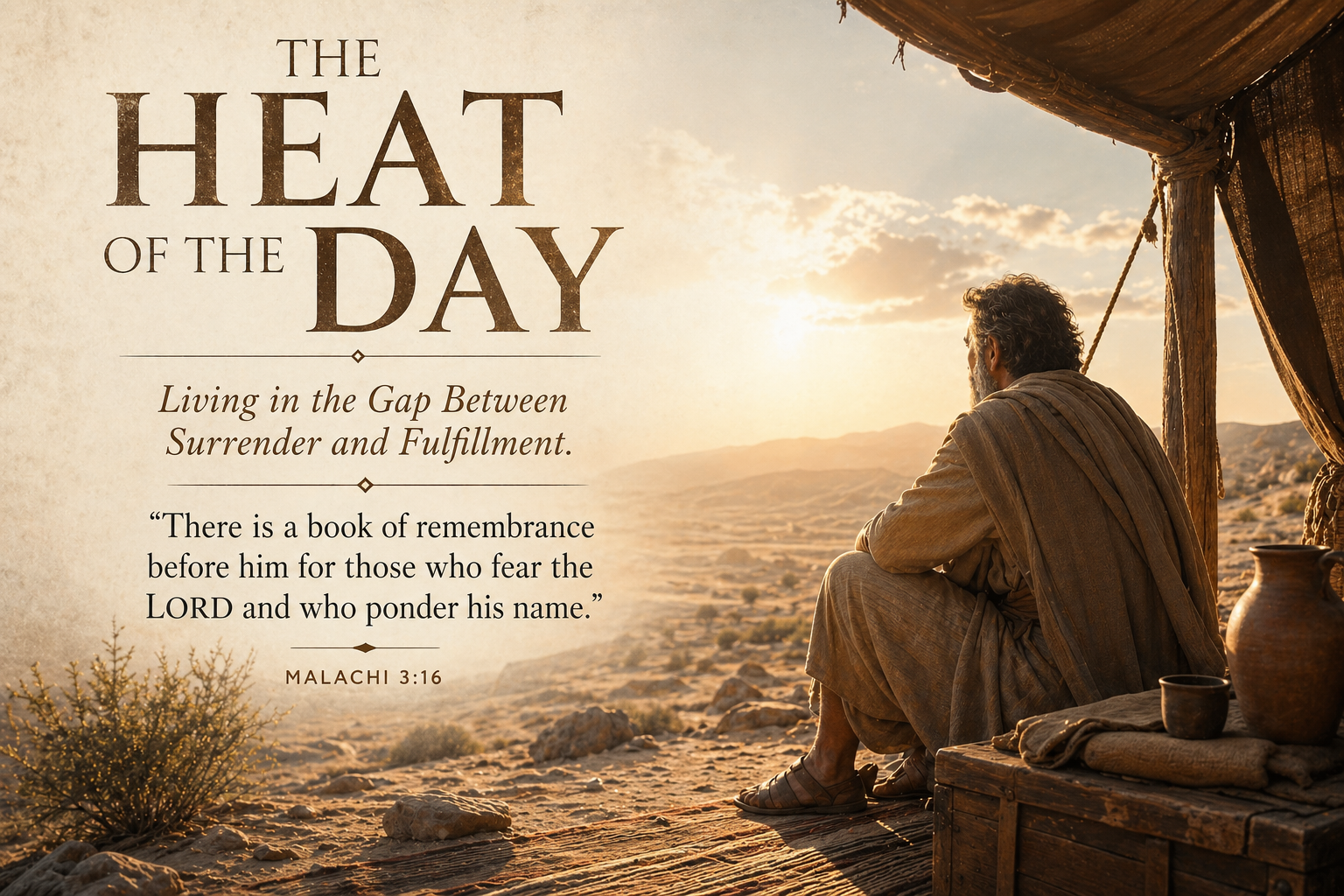
This is why my mind drifted back to Abraham, sitting at the entrance of his tent in the oppressive heat of the day. He wasn’t running, he wasn’t striving, and he wasn't trying to manufacture a miracle. He was simply sitting in the tension of a promise that had been spoken but had not yet arrived. It is a quiet image, but it carries immense weight. He had the word of God, yet the conditions around him looked nothing like the fulfillment. Still, he remained positioned—available, attentive, and present.
That image feels like home for many of us. We look at our world and see broken systems; we see shortcuts rewarded while integrity is overlooked, and surface-level leadership applauded while deeper, quieter faithfulness goes unnoticed. It can feel as though the horizon is empty and the heat of the day is pressing in with no relief in sight. But Malachi reframes that heat for us: it isn’t an oven meant to consume you; it’s a crucible meant to refine you.
Malachi describes a culture that had drifted so far that people were openly asking if serving God was even worth the effort. Yet, in the middle of that cynicism, there was a small, uncelebrated group who still feared the Lord and spoke to one another. They weren’t posturing for influence; they were simply remaining. God’s response to them wasn't to immediately amplify their platform or reverse their circumstances. Instead, He did something far more profound: He wrote it down.
He kept a "Book of Remembrance." While everything in their environment suggested that their faithfulness wasn't "paying off," God was keeping a record. He wasn't measuring their performance by the world’s metrics; He was measuring their posture—the hearts that stayed aligned when it would have been easier to drift.
This changes the frame entirely because it means the 'scoreboard' we are so tempted to watch isn't the one that actually matters. The visible metrics of recognition and progress don’t tell the full story. The real accounting is happening elsewhere, and the final score hasn't been revealed yet.
Eventually, if you stay honest, the question has to surface: "How is anyone supposed to get this right?"
If following Christ touches every internal instinct and every external reaction, the standard feels impossibly high. The more aware you become, the more you realize how often you fall short..I fall short—not just in your actions, but in your motives and your hidden responses. Left alone, that realization will either crush your spirit or harden your heart.
But that tension isn't meant to break you; it's meant to lead you to the "Wink of Grace." The turning point is realizing that the life you are trying so hard to "get right" was never meant to be carried by your strength alone.
The same God who writes the Book of Remembrance is the God who satisfied judgment through Christ. For those anchored in Him, the "Book of Judgment" has already been settled.
This shifts your entire posture. You are no longer striving to earn a standing; you are living from a standing that is already secure. As you surrender—daily, imperfectly, and sometimes reluctantly—you begin to sit in a new kind of awareness. You realize that while God is indeed writing, He isn't building a case against you any longer. He is recording a story of faithfulness that exists entirely within the covering of Christ’s finished work. You are invited to rest in His faithfulness even as He records yours.
This does not remove our responsibility; it simply reframes it. It turns the daily grind of leadership and life into a relational rhythm of returning, realigning, and remaining. This is where real revival lives—not in the visible surge, but in the sustained middle. It’s in the gap between the promise and the fulfillment where you continue to show up, continue to choose alignment, and continue to turn back when you drift. Not because you’ve mastered the path, but because you haven't walked away from it.
So, the radar check for today is less about your perfection and more about your anchor.
Are you reacting to the delays and the inconsistencies of a broken world, or are you anchored in what God has said He will do? If you find yourself in the heat of the day, sitting at the edge of the tent, today, resist the instinct to retreat into the shade of cynicism. That tension isn't wasted, and you aren't forgotten.
Rest in the rest HE has given you. Rest in the faithfulness HE has placed inside you. The Refiner is at work. The Book is open. The judgment is settled. Stay at the door.
Keep your radar up and stay faithful my friends.